
mcp server
chamber
Checks that the numbers, capitalised names, and file names in a claim occur in the indexed note. Local, no model. It does not judge meaning. MIT.
Set up
Runs on your computer. Pick your agent and operating system.
Before you start
- Node.js 20 or newer
{
  "mcpServers": {
    "abm9111-chamber": {
      "command": "npx",
      "args": [
        "-y",
        "@bu7umaid/chamber"
      ]
    }
  }
}
same format Cursor, GitHub Copilot CLI, Junie, JetBrains AI Assistant, Augment (Auggie CLI), Factory Droid, Kiro, Devin CLI +12
Values in angle brackets are placeholders. Restart Claude Desktop after editing its config.Claude Desktop docs
README
synced Oct 14, 2026Chamber
Catches your AI agent quoting a number or a name that isn't in the note it
cites. When Claude Code (or any MCP host) answers from your notes, it is told
to run each claim through chamber_check first. Real output, trimmed:
2 claim(s): 1 supported · 1 terms absent · 0 nothing to check · 0 not judged

[TERMS_ABSENT] Q3 revenue was $420k, up 18% on Q2.
     the cited text does not contain: 420k
     checked: q3-review.md#p0
[SUPPORTED] Enterprise renewals moved to Dana Ortiz in August.
     every term Chamber recognises occurs in the cited text
     checked: q3-review.md#p0
The note says $240k. The agent wrote $420k. Edit the note afterwards and
the same check returns STALE instead of a verdict, because what it is checking
against has changed.
claude mcp add -s user chamber -- npx -y @bu7umaid/chamber mcp
No model, no account, no network: the check is deterministic string matching
over node:sqlite and files on your disk. It checks numbers, capitalised
names, domains, file names and counts. It does not check meaning, so a negated
or reversed sentence built from the note's own words still passes. See
what a verified citation does and does not prove.
Beyond the check: answers that cite their sources, and a daily job that tells you when a source changed underneath a conclusion you already trusted.
Run the check
The npx line above is all most people need. Two other ways in:
From a checkout (Node 23.6+). TypeScript runs straight from the repo, with
no build step, config, model or network. try builds a throwaway workspace,
runs the real code paths and deletes it.
git clone https://github.com/abm9111/chamber.git && cd chamber && npm ci && node --experimental-strip-types src/cli.ts try
If /mcp does not list chamber_check, the host started the server with a
minimal PATH. Take the interpreter from command -v node in your own shell
and point it at the published bin or at a checkout's src/mcp_server.ts. Those
are different files:
# published bin: bin/chamber.js loads dist/. This is not src/mcp_server.ts.
claude mcp add -s user chamber -- "$(command -v node)" /path/to/node_modules/@bu7umaid/chamber/bin/chamber.js mcp

# checkout only. src/mcp_server.ts is not in the npm install.
claude mcp add -s user chamber -- "$(command -v node)" --experimental-strip-types /path/to/chamber/src/mcp_server.ts
Ingest and chamber_ask need config; the check does not. See
for ingest and chamber_ask.
What people actually do
There is no public trail of Chamber users yet. These are the adjacent failures on X, which are the reason the check exists.
- Pointing Claude Code at an Obsidian folder reads files. It does not check the sentence. Richard Kovacs, 28 Sep 2026: Claude returns a list of sources and he checks them. The remaining failure he names is confirmation bias, and he treats that as discipline.
- A tool the agent must remember to call is not a gate.
Saksham Arora, 2 Oct 2026:
a shared-memory MCP only recalled a session if the other agent decided to
search, so he put a hook before every message.
chamber_checkis the same shape. MCPinstructionsask Claude to call it. Nothing blocks the turn if it skips. A Stop hook that requires a receipt is the missing piece; it is not in this repo yet. - Viral vault posts (99.7% recall, thousands of links in minutes) are not
measurements. The number in this repo is the 200-claim set in
docs/KNOWN_LIMITATIONS.md§2: invented values mostly caught, negations not.
See it in two minutes
The checkout command above builds a throwaway workspace, runs the real code
paths against it, and deletes it (--keep to look around). It does not open
a database.
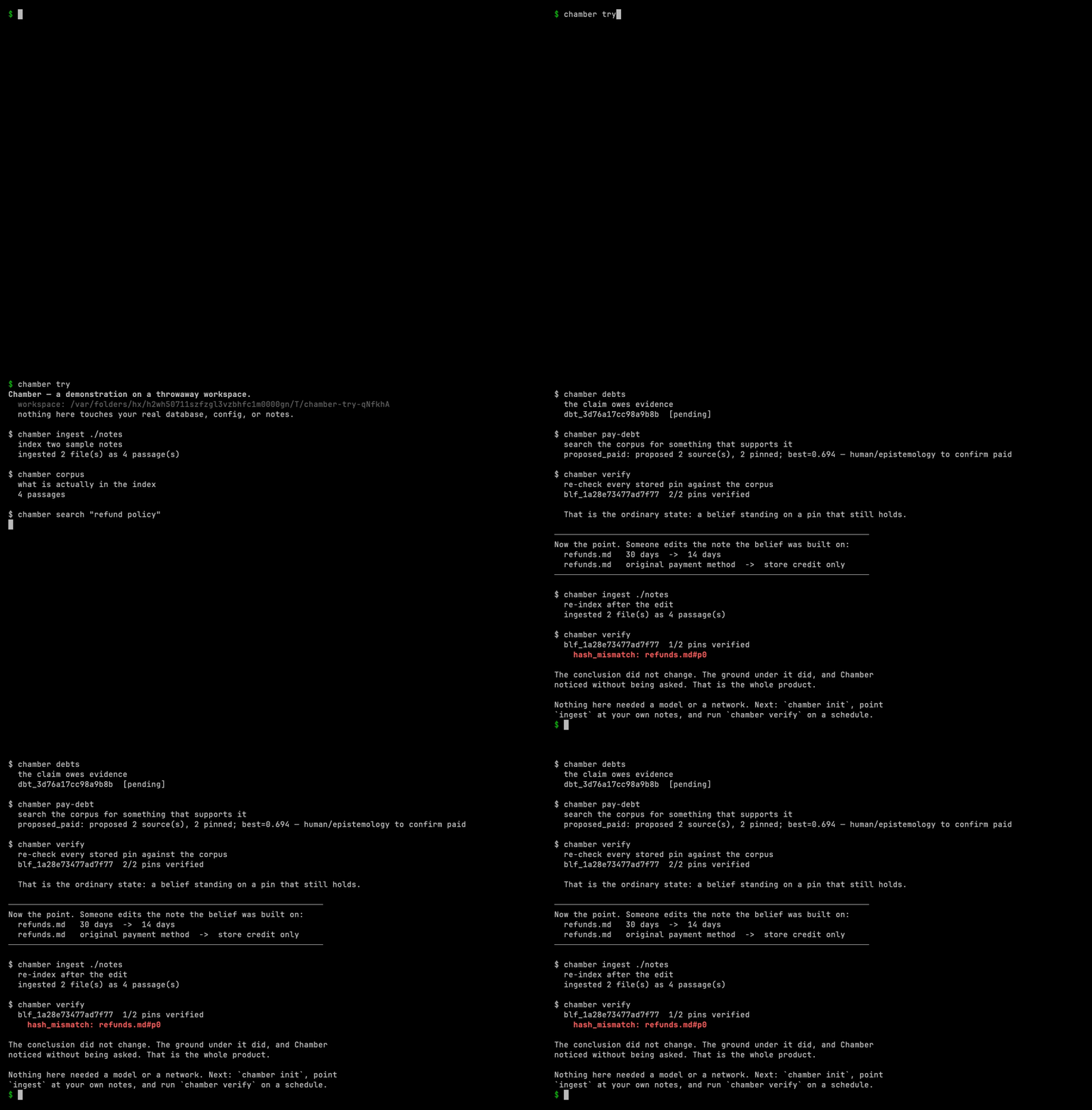
That recording is scripted from assets/demo.tape rather
than hand-captured, so it is regenerated when the output changes instead of
quietly showing a version of Chamber that no longer exists. Everything below is
that checkout command's actual output, trimmed:
$ chamber believe belief "Customers may return any purchase within 30 days of delivery."
  committed blf_ddcf4f3c9b2e81b8
  an unsourced assertion is not refused — it mints citation debt.

$ chamber debts
  dbt_18bd1c1171cdbfcb  [pending]

$ chamber pay-debt
  proposed 2 source(s), 2 pinned; best=0.694

$ chamber verify
  blf_ddcf4f3c9b2e81b8  2/2 pins verified
That is the ordinary state: a belief standing on evidence that still holds. Then
someone edits the note it was built on — 30 days becomes 14 days:
$ chamber ingest ./notes
  ingested 2 file(s) as 4 passage(s)

$ chamber verify
  blf_ddcf4f3c9b2e81b8  1/2 pins verified
    hash_mismatch: refunds.md#p0
Nobody asked it to re-examine that belief. The conclusion did not change; the ground under it did, and the exit code is non-zero, so a scheduled job can act on it. That is the whole product.
Four more scenarios — a rolled-back ledger caught by an outside anchor, a
sandbox that refuses rather than degrade, a hostile tool catalogue rejected —
are in demos/, and run in CI so they cannot drift from the code.
A dictionary for the words above
Everything Chamber does is rows in one SQLite file. Each term in the transcripts names a table or a hash:
| Word | What it actually is |
|---|---|
| passage | one chunk of one markdown file. refunds.md#p0 is file path + chunk index. |
| belief | a row in belief: one asserted sentence, linked to the passages it stands on. |
| pin | a sha-256 of a cited passage's stored title, body and ref, taken at the moment of citation and kept in belief_source. |
| verify | re-read every pinned passage, recompute the hash, compare. Any mismatch exits non-zero. No model involved. |
| citation debt | a row in citation_debt, created when an assertion commits with no source. The same claim cannot commit again until the debt is paid. |
| pay-debt | retrieval proposes passages for the indebted claim; accepting them pins them. |
| APORIA | the verdict when no retrieved passage supports an answer. The reply is "I don't know", recorded as that. |
| gate | a check and a write inside one SQLite transaction — both commit or neither does. |
| audit log | append-only audit_event; each row's hash covers the previous row's hash, so editing history breaks every hash after it. |
| anchor | the log's root hash stored outside the database, so truncating the log is detectable rather than silent. |
| the scheduler | a launchd/systemd job running ingest + verify, notifying only on drift. |
None of it is hidden machinery: sqlite3 ~/.local/share/chamber/chamber.sqlite '.tables' shows the whole thing.
Answers that cite their sources
With a model configured, chamber ask judges every sentence on its own
citations. Against the same two sample notes, on a local 30B:
$ chamber ask "summarise our refund policy"

Customers may return any purchase within 30 days of delivery [2]. Refunds
are issued to the original payment method, usually within five working days
of the returned item arriving at the warehouse [2]. However, perishable goods
and personalised items cannot be returned once dispatched [1].

  [ALLOWED] Customers may return any purchase within 30 days of delivery [2]. Refu
     sources: refunds.md#p0 — refunds › Refund policy, refunds.md#p1 — refunds › Refund policy › Exceptions
The model is shown [1]…[k] and never a document id or a hash, so it cannot
fabricate a citation even in principle — the numbers are resolved back to files
after the answer is written. A sentence that cites nothing is marked
UNSUPPORTED: recorded, but not treated as load-bearing. A sentence whose
numbers, names or domains are not in the passage it cites loses that citation
too, and says which terms were missing (terms_absent) — a real passage is not
evidence for a claim it does not contain. Headings in an answer print as
[HEADING] and are not recorded.
Asking something the corpus cannot answer is the more important case:
$ chamber ask "what should a customer do if they want to return a perishable
               item after the office has closed?"

I don't know

  [APORIA] I don't know
Both notes are in the index and both are relevant. Neither answers the question, so nothing is composed from the pieces.
For ingest and chamber_ask, not for the check
npm link                 # puts `chamber` on your PATH
chamber init             # writes ~/.config/chamber/config.json
Then edit that config to add a notes folder and a model:
{
  "database": "~/.local/share/chamber/chamber.sqlite",
  "model": { "base": "http://127.0.0.1:8087/v1", "name": "your-model", "mode": "openai" },
  "ingest": [{ "root": "~/Notes", "exclude": ["transcripts", "attachments"] }]
}
model.base may name any OpenAI-compatible endpoint. A loopback address needs
no API key; anything else reads CHAMBER_API_KEY from the environment, never
from the file.
chamber ingest           # index every configured root
chamber ask "..."        # ask, with citations
chamber verify           # re-check stored pins against the corpus
chamber corpus           # what is actually in the index
Set your excludes before the first ingest. There is no default exclude list.
Pointed at a folder of exported chat logs, Chamber will happily index all of
them and answer from them — see chamber corpus and
docs/KNOWN_LIMITATIONS.md entry 11.
If the root is an Obsidian vault, exclude .obsidian, .trash, and
*sync-conflict* before that first ingest. A symlinked folder is indexed under
the link path and comes back STALE under the real path.
Use it as a CI drift gate
The same verify loop works on a repo: claims in docs pinned to passages of
code or policy, chamber verify --json failing the build when the ground
moves. One line in a workflow — this repo ships the action:
- uses: abm9111/chamber@v0.1.9
docs/CI_DRIFT_GATE.md is the one-page recipe;
demos/06_ci_drift_gate.ts is the runnable
transcript.
Run it daily
deploy/launchd/com.chamber.verify.plist (macOS) and deploy/systemd/
(Linux) run ingest and verify on a schedule, and raise a notification only when
something drifted. A check that correctly reports nothing on most days is a
check you stop reading, so it stays quiet until it isn't.
Render it in Obsidian
The companion plugin Chamber Drift
renders verify --json's report as a vault sidebar panel and a per-note
banner — nothing more. It never verifies and never writes; Chamber does both,
on its own schedule, outside Obsidian. Setup, including the report-writing
one-liner and the Obsidian Sync caveat: docs/OBSIDIAN.md.
Use it from an AI coding agent
An agent that reads your vault with its own tools can check what it is about
to tell you. chamber_check takes the agent's claims and the notes it says
they came from, and answers per claim (abridged):
[SUPPORTED] One NVIDIA A100 80GB or an L40S can serve about 1,000 users for code completion.
     found in: ai-coding-setups-march-2026.md#p25
[TERMS_ABSENT] One NVIDIA A100 80GB can serve about 2,000 users for code completion.
     the cited text does not contain: 2000
The check uses no model. It confirms the note is indexed, and unchanged on disk since
it was indexed (STALE otherwise: the agent read one text and the index holds
another, so neither verdict would be about what was read). Then it checks that
every number, capitalised name, domain, file name and count in the claim occurs
in the note. That catches invented values. It does not check lowercase names or
ordinary words, and it does not catch a negated or reversed sentence
built from the note's own words — see
docs/KNOWN_LIMITATIONS.md §2 for what it was
measured to catch. It writes nothing unless called with record: true. Then
the supported claims are committed through the gate, pinned to the passages
that hold them, and chamber_verify reports any whose pinned passage changes,
once the note is re-ingested.
The server tells the host this in its MCP instructions, which Claude Code
puts in the agent's context. That is a prompt contract, not a runtime gate.
Four tools, not three. chamber_check is the one above. The other three cover
the rest: chamber_ask (Chamber's own configured model answers, with the same
per-claim verdicts), chamber_verify (drift in recorded claims) and
chamber_corpus (what is indexed). CHAMBER_PYTHON is optional, and only for
chamber_ask's semantic retrieval; a missing onnxruntime falls back to hash
vectors. Ingest stays on the CLI so the model cannot re-index its own evidence.
Register the server with the command above. That npx runs
the published bin (dist/).
The server re-reads config on every tool call, so an edit to model takes
effect on the next call without a reconnect; a CHAMBER_* variable set in the
server's own environment still outranks the file. The database is the
exception: it stays pinned for the life of the process, because a call may be
awaiting the model with it open — reconnect the server to switch databases.
The resolved database, mode and base go to stderr on first use and whenever
they change, so the host's MCP log can settle what the server is using.
Nothing on that surface can activate a skill, approve a pending write, or ingest — the gates exist so a human passes through them, and handing a model the approval side would invert them rather than weaken them.
chamber_ask is not read-only, and the write is not just bookkeeping: every
claim goes through the commit gate, so a claim with verified citations is
recorded as a belief with its pins — which is exactly what chamber verify
later re-checks for drift. Unsourced assertions mint citation debt; spend is
recorded. This is the same behaviour as chamber ask on the command line. The
guarantee is that the gate is not bypassed, not that nothing is written.
What a verified citation does and does not prove
Chamber proves a cited passage is the passage it claims to be — unmodified, still present, still saying what the citation says it says.
It cannot tell you the claim follows from the passage. A model can cite a real source and misread it, and every layer here will pass it. That is a stated non-goal, it has been observed happening, and it is not solved.
Read docs/KNOWN_LIMITATIONS.md before trusting
any output. Eighteen limitations are documented there, including the two least
flattering. The sandbox does not isolate: a docker detection can relabel to a
subprocess, CHAMBER_SANDBOX_REQUIRED=1 does not fail closed, and a probed run
read $HOME and resolved DNS (docs/KNOWN_LIMITATIONS.md §1). That path is off
chamber_check. Do not read "sandbox" as containment. Citation debt blocks a
verbatim repeat reliably, while the paraphrase leg over it is a heuristic:
calibration found no cosine threshold that separates a restatement from a
contradiction. A numeric and negation check now removes the worst of that — an
operator correcting an indebted claim is no longer refused for restating it —
but two of five true paraphrases still slip through, and a contradiction that
is neither numeric nor negated still reads as a repeat.
The invariant
No assertion may become executable, citable, or load-bearing except through a gate whose check and write commit in one transaction — anything else may decay, park, or be defeated, but it may never silently pass.
| Gate | Blocks when |
|---|---|
commitBelief | assertion with open blocking citation debt; missing or unverifiable pins; a defeater used as a source; a belief-typed commit on the fast path |
tryActivateSkill | open holds; load-bearing stale beliefs; content ≠ last critic-cleared hash; capability manifest over-ask |
Both gates write into a hash-chained audit log — entry_hash = sha256(prev_hash || canonical JSON) with an incremental Merkle tree — so altering a past
decision breaks every hash after it. Retraction types (defeater, unknown)
commit freely and never mint blocking debt.
Defaults are refusals: memory and skill writes require approval, learned skills land in quarantine rather than applying silently, and a pending write that expires is not an approved one.
Development
npm test        # 308 tests
npm run typecheck
npm run probes  # adversarial probes; each one asserts a defect is absent
npm run probes passes today, and that statement is dated the moment it is
written — run it rather than trust it. Two of these probes (sandbox_escape,
debt_paraphrase) spent weeks red against real, open defects before their
fixes landed, and they are wired in as gates precisely because they can go red
again. A gate that cannot fail reports safety it never checked.
Layout
src/ask.ts              retrieval → prompt → per-claim citation gate
src/mcp_server.ts       MCP surface: ask, check, verify, corpus
src/commit_belief.ts    the belief gate; check and write in one transaction
src/pins.ts             content pins and drift verification
src/audit.ts            hash-chained log + incremental Merkle
src/config.ts           settings: flag → env → config file → default
src/db.ts               opens the database, loads every schema
probes/                 adversarial probes, run by npm run probes
demos/                  the four scenarios above, run in CI so they cannot rot
docs/KNOWN_LIMITATIONS.md   what does not work, and what it costs
docs/NEXT_LEVEL_PLAN.md     historical plan; several items already shipped
MIT.