
mcp server
ltpmcp
Compile-once planning (LTP) — turn a goal into a verifiable, token-cheap plan with static safety verification before execution. Python lib · CLI · MCP server · FastAPI.
Set up
Runs on your computer. Pick your agent and operating system.
Before you start
- uv (`curl -LsSf https://astral.sh/uv/install.sh | sh`)
{
  "mcpServers": {
    "ltpmcp": {
      "command": "uvx",
      "args": [
        "mcpaisuite-ltpmcp"
      ]
    }
  }
}
same format Cursor, GitHub Copilot CLI, Junie, JetBrains AI Assistant, Augment (Auggie CLI), Factory Droid, Kiro, Devin CLI +12
Values in angle brackets are placeholders. Restart Claude Desktop after editing its config.Claude Desktop docs
README
synced Oct 23, 2026📐 ltpmcp — Compile goals into deterministic, verifiable plans
Part of the MCP AI Suite.
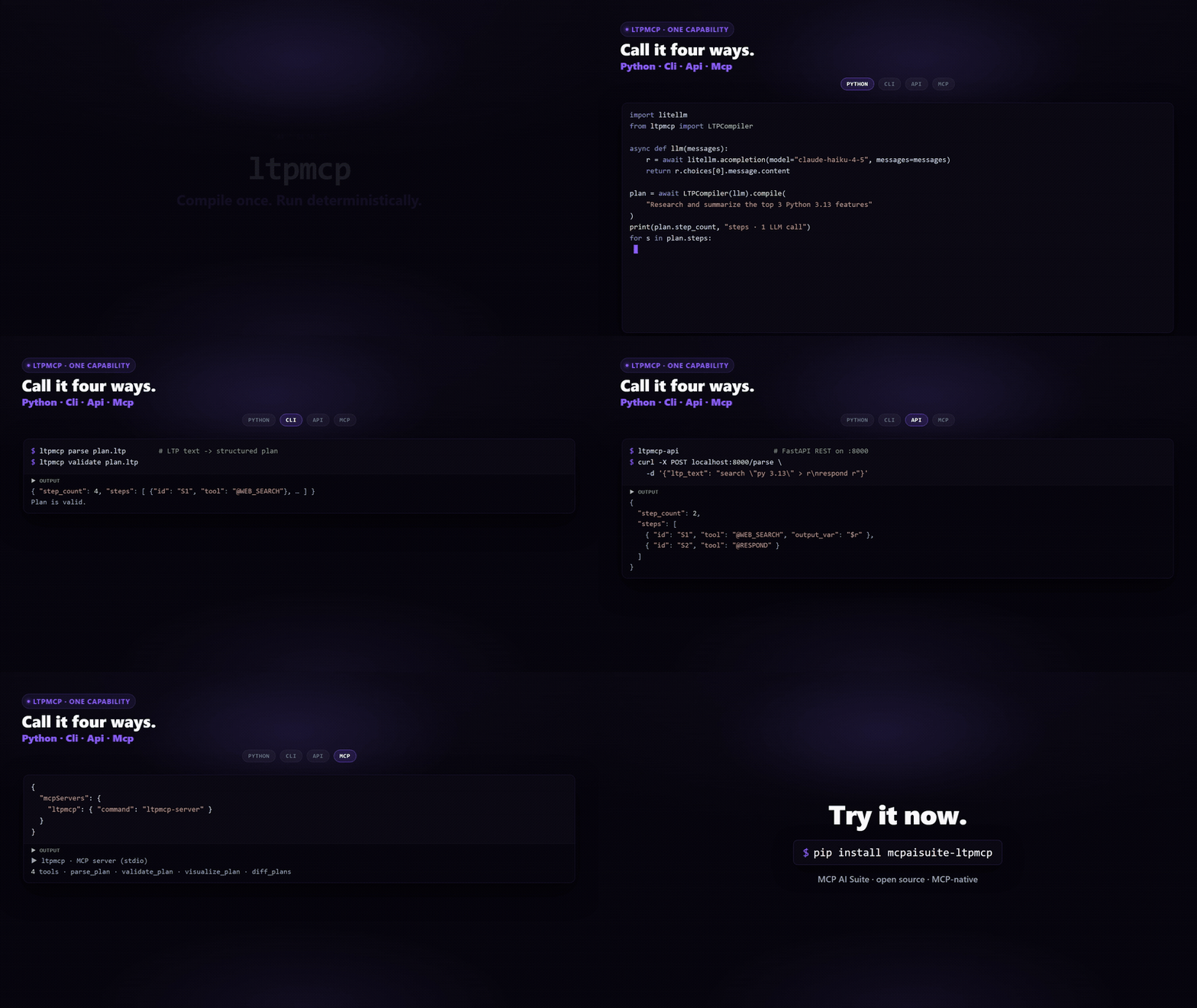


ltpmcp compiles a natural-language goal into a deterministic, verifiable execution plan in a single LLM call — then runs it step by step with parallel branches, conditionals, loops, and retries. Compile once, run predictably and token-cheap. Python library · CLI · MCP server · REST API.
pip install mcpaisuite-ltpmcp
Table of Contents
Features
- Single-call compilation -- converts a natural-language goal into a structured execution plan with one LLM call
- Micro-CLI syntax -- compact ~20 tokens/step format (search, fetch, exec, respond) for token efficiency
- Deterministic runtime -- executes plans step-by-step with variable passing, conditionals, and loops
- Conditional branching --
?IF ($var == "value") THEN ...with numeric, string, and contains operators - FOREACH iteration -- iterate over list variables with per-item processing
- ON_FAIL error handling -- retry N times, GOTO fallback step, or terminate with message
- RE-PLAN -- dynamically recompile the plan mid-execution when results invalidate the approach
- Parallel execution groups -- concurrent step execution within the same group
- Type casting -- output variables cast to int, float, list, bool, or json
- Mermaid visualization -- export plans as Mermaid flowcharts
- Plan diff --
diff_plans(a, b)structural diff of two plans (added/removed/changed/reordered steps) - Library, CLI, MCP & API -- import it, or use the
ltpmcpCLI (parse/validate/visualize/diff), theltpmcp-serverMCP server (4 tools:parse_plan,validate_plan,visualize_plan,diff_plans), or the optionalltpmcp-apiFastAPI app (/parse,/validate,/visualize,/diff,/compile)
Installation
pip install mcpaisuite-ltpmcp
# Optional extras:
pip install mcpaisuite-ltpmcp[dev]    # Development tools
pip install "mcpaisuite-ltpmcp[api]"  # FastAPI server (ltpmcp-api)
Console scripts: ltpmcp (CLI), ltpmcp-server (MCP, stdio), ltpmcp-api (FastAPI). Runtime deps: pydantic, structlog, click, mcp.
Quick Start
from ltpmcp import LTPCompiler, LTPRuntime

async def my_llm(messages):
    # Your LLM completion function
    return await call_llm(messages)

compiler = LTPCompiler(llm_fn=my_llm)
plan = await compiler.compile("What is the weather in Ibiza?")

runtime = LTPRuntime()
result = await runtime.execute(plan, tool_executor=my_tool_fn, llm_fn=my_llm)
print(result["response"])
Configuration
LTP is configured programmatically via the compiler and runtime constructors. No environment variables are required.
| Parameter | Description |
|---|---|
llm_fn | Async callable (messages) -> str for plan compilation and LLM ops |
tool_executor | Async callable (tool_name, args, namespace) -> dict for tool execution |
max_replans | Maximum RE-PLAN recompilations allowed (default: 3) |
API Reference
LTPCompiler
Compiles a user goal into an LTP plan using one LLM call with Micro-CLI syntax.
compiler = LTPCompiler(llm_fn=my_llm)
plan = await compiler.compile(goal, context="") -> LTPPlan | None  # None on compile failure
LTPRuntime
Deterministic execution engine for LTP plans.
runtime = LTPRuntime(audit_fn=None)
result = await runtime.execute(plan, tool_executor, llm_fn,
                               agent_fn=None, namespace="default",
                               max_replans=3, progress_callback=None) -> dict
LTPPlan / LTPStep
plan.steps         # list[LTPStep]
plan.step_count    # int
plan.variables     # dict[str, Any]
plan.raw           # str -- original Micro-CLI text
Utility Functions
from ltpmcp import validate_plan, plan_to_mermaid, diff_plans

errors = validate_plan(plan)       # list[str] -- validation errors
mermaid = plan_to_mermaid(plan)    # str -- Mermaid diagram
changes = diff_plans(plan_a, plan_b)  # dict -- added/removed/changed/reordered + winner-free summary
Architecture
LTPCompiler sends a single prompt with Micro-CLI syntax examples to the LLM, which returns a compact step-by-step plan. The compiler converts Micro-CLI commands to standard LTP format (with @TOOL references), which is parsed by LTPParser into an LTPPlan AST. LTPRuntime then executes each step sequentially, resolving $variable references with dot-notation support, evaluating conditions, handling FOREACH loops, and routing tool calls through the provided executor.
Testing
pip install -e ".[dev]"
pytest tests/ -v
License
Apache-2.0 — see LICENSE.
Open source for individuals and open-source projects. For commercial use in closed-source products, a commercial license is available — contact contact@mcpaisuite.com.