
mcp server
mcprelay
Reliability layer for MCP tool calls — dead-letter queue + replay, per-tool policies, and observability for MCP servers. Local-first, pluggable queue backends (SQLite/RabbitMQ).
Set up
Runs on your computer. Pick your agent and operating system.
Before you start
- Node.js 20 or newer
{
  "mcpServers": {
    "yamillanz-mcprelay": {
      "command": "npx",
      "args": [
        "-y",
        "@yamillanz/mcprelay"
      ]
    }
  }
}
same format Cursor, GitHub Copilot CLI, Junie, JetBrains AI Assistant, Augment (Auggie CLI), Factory Droid, Kiro, Devin CLI +12
Values in angle brackets are placeholders. Restart Claude Desktop after editing its config.Claude Desktop docs
README
synced Oct 14, 2026mcprelay
The reliability layer for MCP tool calls. Middleware that wraps any stdio MCP server and adds policy, observability, and a dead-letter queue with replay around tools/call.
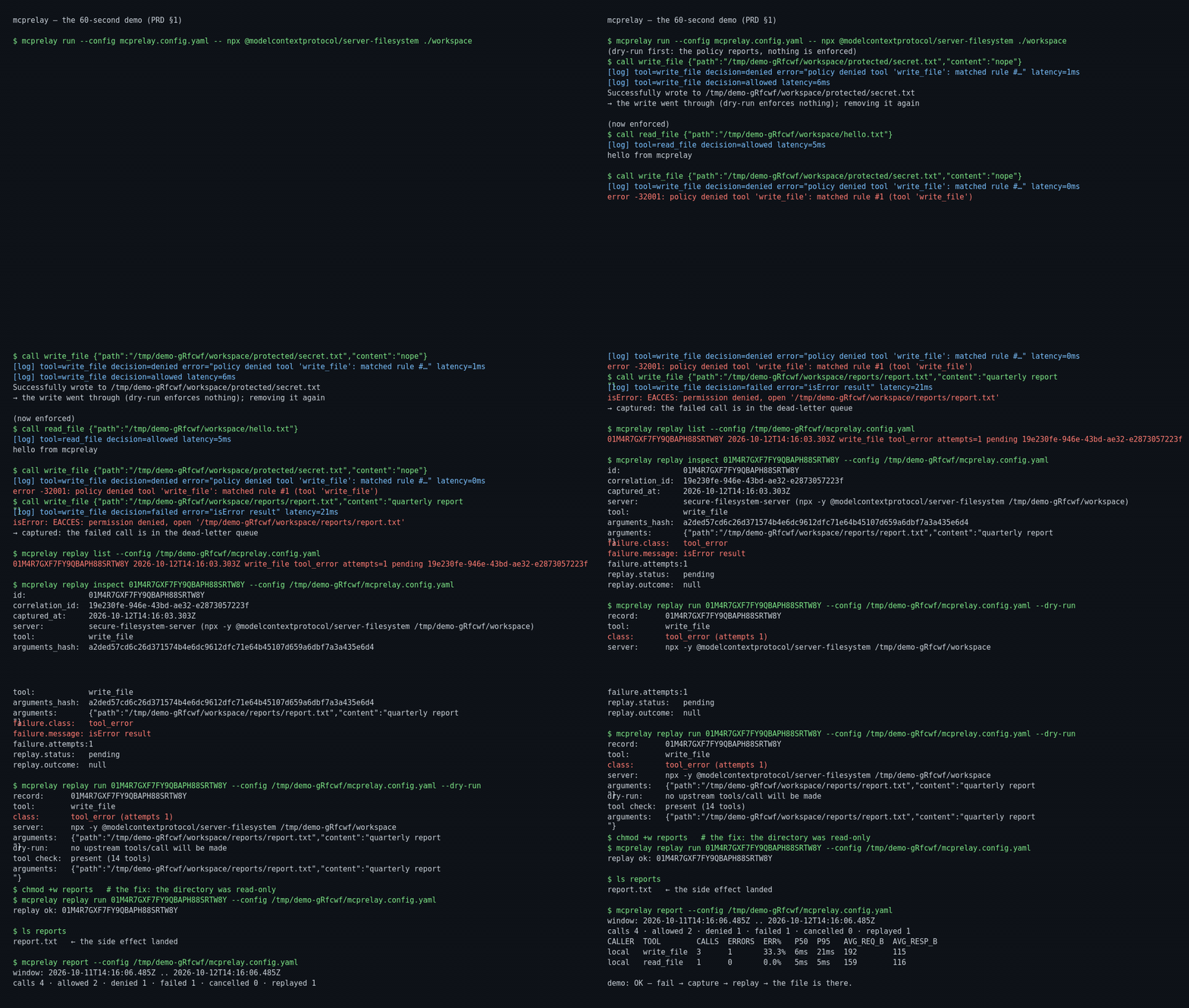
Status: v1.0 — the first stable release. Wrap any stdio server or a remote Streamable HTTP server with the same pipeline: per-call timeouts and classified retries, declarative allow/deny policy (with dry-run), a durable, redacted dead-letter queue, replay as redrive for side effects (including batch replay), an idempotency guard against duplicates, a RabbitMQ-backed DLQ beside the zero-infra SQLite default, per-tool latency/error/caller metrics persisted on every call and rendered by
mcprelay report, and caller identities (config profile, static API keys,--identity) that feed policy and the report — with client credentials validated at the edge and never forwarded upstream. Seedocs/PRD.mdfor the architecture and scope; post-v1 items (bench/, FR-A2 JWT/mTLS, more adapters) are tracked as follow-ups.Published on npm as
@yamillanz/mcprelay(the baremcprelayname is blocked by npm's name-similarity policy; scoped fallback per PRD §11 — the installed command is stillmcprelay).
Quickstart (client config)
Point your MCP client at mcprelay instead of the server — one line, no server changes. Claude Desktop / Cursor (claude_desktop_config.json / mcp.json):
{
  "mcpServers": {
    "filesystem": {
      "command": "npx",
      "args": [
        "-y",
        "@yamillanz/mcprelay",
        "run",
        "--",
        "npx",
        "-y",
        "@modelcontextprotocol/server-filesystem",
        "/path/to/project"
      ]
    }
  }
}
OpenCode (opencode.json):
{
  "mcp": {
    "filesystem": {
      "type": "local",
      "command": [
        "npx",
        "-y",
        "@yamillanz/mcprelay",
        "run",
        "--",
        "npx",
        "-y",
        "@modelcontextprotocol/server-filesystem",
        "/path/to/project"
      ]
    }
  }
}
Or from a terminal:
npx @yamillanz/mcprelay run -- npx @modelcontextprotocol/server-filesystem .
Requires Node.js ≥ 20.19.
Remote HTTP servers
The client side stays stdio; the upstream can be a remote Streamable HTTP MCP server:
mcprelay run --http https://mcp.example.com/mcp
or from a client config:
{
  "mcpServers": {
    "remote": {
      "command": "npx",
      "args": ["-y", "@yamillanz/mcprelay", "run", "--http", "https://mcp.example.com/mcp"]
    }
  }
}
Upstream credentials are the middleware's own — client tokens are never forwarded upstream (FR-A3). Configure them in mcprelay.config.yaml; values are never logged or persisted:
upstream:
  http:
    headers:
      authorization: Bearer <your-token>
Policy, retries, DLQ capture, and replay work identically over HTTP, and records remember the transport so replay reconnects to the same endpoint. Two boundaries to know: JSON-RPC batch frames are stdio-only (the 2026-07-28 revision removed batching; over HTTP the middleware answers with a clear error), and OAuth/JWT identities land with M9.
What works today
- Wrap any stdio server 1:1 —
mcprelay run -- <server command…>(alsomcprelay -- <server command…>). The upstream runs unmodified and unaware. - Wrap a remote HTTP server —
mcprelay run --http <url>speaks Streamable HTTP to the upstream while the client side stays stdio. Same policy, retries, DLQ, replay, and logs; upstream headers come fromupstream.http.headers. - Protocol fidelity — everything except
tools/callpasses through semantically unchanged:tools/list,resources/*,prompts/*,completion/*,logging/setLevel, server→client requests (sampling/createMessage,elicitation/create,roots/list), progress, custom methods, and JSON-RPC batch frames. - Policy without surprises — declarative allow/deny by tool (globs), caller identity, and argument matchers (
equals,in,prefix,regex,max_length, numeric bounds), with most-specific-wins precedence. Denied calls get a standard MCP error (-32001), an audit entry, and a log line — and are never forwarded upstream or written to the DLQ.tools/listis never filtered.--policy-dry-runreports decisions without enforcing;mcprelay policy testevaluates a call (or a stored failure) before you enforce anything. - Timeout + classified retries — per-call timeout; transient failures retry with exponential backoff, gated by the failure-class taxonomy: timeouts and upstream errors retry only for tools marked
idempotent: true;isErrorand protocol errors never retry; client cancellation aborts without retrying. - Dead-letter queue — a call that ultimately fails is written to the configured queue provider before the client sees the error, with redacted arguments, a sha256 hash of the raw arguments, failure class, attempts, and correlation id. Records survive restarts. SQLite is the zero-infra default; RabbitMQ (
queue.provider: rabbitmq) publishes persistent, confirm-acknowledged captures to a durablemcp.dlx/mcp.dlqtopology. - Replay as redrive —
mcprelay replay run <id>re-executes the stored call, and the replay's own (redacted) result or error is captured into the audit trail.--dry-runinspects with zero upstreamtools/call. - Batch replay —
mcprelay replay run --allredrives every pending record matching thelistfilters, sequentially and concurrently safe through atomic claims, with per-record outcomes, a summary, and CI-meaningful exit codes. - Duplicate guard — successful keyed calls are indexed; replay refuses a duplicate within
reliability.replay.dedup_windowunless--forceis given. - Structured logs — one JSON line per intercepted call on stderr with correlation id, latency, payload sizes, attempts, and decision.
- Metrics and
report— every intercepted call is persisted as a call event (decision, latency, payload sizes, attempts, caller) — the same data as its log line.mcprelay reportrenders per-tool latency p50/p95, error rate, and caller attribution for a time range, with--jsonfor CI, bounded bystore.retention_days(default 30 days). - Caller identities —
identity.profile(defaultlocal) names the caller of a stdio wrap;identity.keysmaps static API keys to identities;run --identity <name>overrides the profile. Identities feed policycallerrules, logs, call events, andreport. A client credential in_meta.authorizationis validated at the edge (unrecognized →-32003, denied, never forwarded) and stripped from every relay.
What replay means
A replayed call's response cannot go back to the agent that made it — that session is over. Replay is redrive for side effects: the call runs upstream, the side effect lands, and the (redacted) result or error is stored in the audit trail, which is the only place a replay's outcome can be inspected. Read-only tools are rarely worth replaying; mark them effects: read and --dry-run will say so.
Because secrets are never stored in the clear, replay refuses to run a record whose arguments contain [REDACTED] values. Supply them explicitly:
mcprelay replay run <id> --set api_key=… # then the call runs with the real value
How it compares
The MCP gateway space is crowded; the operational failure path is not. Scan date 2026-10-12 (star counts verified that day; links per row):
| Project | Stack | What it does | Gap we exploit |
|---|---|---|---|
microsoft/mcp-gateway (874★) | .NET/TS, K8s | Enterprise reverse proxy, control plane, portal | K8s/enterprise orchestration; not local-first; no DLQ/replay |
P4ST4S/mcp-audit (8★) | Go | Audit proxy: signed logs, redaction, allow/deny | Audit-first; explicitly avoids retrying tools/call; no DLQ/replay |
rsh1k/mcp-gate (3★) | Python | Policy firewall, hash-chained audit | Security-first; no failure-capture/replay workflow |
mcpgatehq/gateward (0★) | Python | Built-in security rules, stdio only | Fixed rules; no reliability layer |
kgeg401/mcp-guard (0★) | Go | Policy, redaction, signed audit, replay --id | Replay is audit-integrity oriented; no retry pipeline, no pluggable queue |
JinBeiCN/mcp-gateway (0★) | Go | Auth, RBAC, rate limits, prompt-injection detection | Security-first; no DLQ |
yogesh895/gate-mcp (0★) | Node | Control plane + admin UI, multi-tenant | Heavy enterprise scope; no DLQ/replay |
bentabol/mcp-retry (0★) | Python | Retry, idempotency dedup, circuit breaker | Resilience only (no policy/audit/DLQ); not TypeScript |
CK-Rajput/mcp-resilient (0★) | Python | Retry/circuit-breaker decorator, fallback chains | Library-level, client-side; no DLQ store/replay |
Commercial gateways (mcpgateway.com, mcptrail.com) cover similar ground as SaaS; "replay" elsewhere in the ecosystem mostly means record/replay for tests (nock/msw-style fixtures). The niche that is still empty: operational dead-letter capture + inspection + replay of failed tool calls as the core of a product — TypeScript, local-first, pluggable real-MQ backends.
Design decisions
The full set lives in docs/adr/ — every ADR records its rejected alternatives. The four that shape the product most:
- ADR-0004 — DLQ persistence:
better-sqlite3(synchronous, WAL) as the zero-infra default; capture completes before the client sees the error; secrets redacted, raw arguments hashed. Rejected:node:sqlite(would drop Node 20),sqlite3,sql.js(no real durability story). - ADR-0005 — replay semantics: replay is redrive for side effects — the result lands in the audit trail, and
[REDACTED]arguments block execution until supplied via--set. Rejected: storing raw secrets (violates NFR-4) and silently sending redacted values upstream (executes a different call than the one that failed). - ADR-0008 — RabbitMQ topology: a durable
mcp.dlx/mcp.dlqexchange/queue holds the immutable capture with publisher confirms; the SQLite replay index serves queries. Rejected: peek-via-requeue (O(n) scans, ambiguous claim state, crash-window duplication) and publish-only event streams (nolist/get). - ADR-0010 — identity resolution: profile identities for stdio, static API keys mapped to identities via the standard
_meta.authorizationBearer shape; unrecognized credentials denied at the edge (-32003) and stripped from every relay. Rejected: requiring credentials (breaks zero-config), env-var identities, custom credential schemes.
Dead-letter queue
mcprelay replay list                          # captured failures (all statuses)
mcprelay replay list --status pending --json  # filters + machine-readable
mcprelay replay inspect <id>                  # full record (redacted arguments)
mcprelay replay run <id> --dry-run            # tool present? duplicate risk? zero side effects
mcprelay replay run <id>                      # re-execute; result captured in the audit trail
mcprelay replay run <id> --force              # allow a duplicate within the dedup window
mcprelay replay run --all                     # batch: redrive every pending record
mcprelay replay run --all --tool fs/write_file --since 2026-10-01T00:00:00Z
mcprelay replay run --all --dry-run           # inspect each record, zero side effects
The replay CLI and the middleware share the SQLite files (WAL + busy_timeout) and never start a server unless a replay actually runs.
RabbitMQ provider
queue:
  provider: rabbitmq
  rabbitmq: { url: amqp://localhost, exchange: mcp.dlx, queue: mcp.dlq }
  sqlite: { path: ./.mcprelay/queue.db } # local replay index (list/get/claim)
Captures are published persistently and confirmed before the client sees the error; the broker holds the immutable capture. The replay CLI reads the local index, so filters, atomic resolve, claims, and dedup behave exactly as with SQLite — and if the broker is unreachable the capture still lands locally with a visible warning. Nothing is lost; a broker outage degrades, it never drops records.
One-command demo — RabbitMQ + middleware + example server, ending on a successful replay:
docker compose up --build # fail → DLQ (visible in mcp.dlq) → replay → "demo: OK"
Report
Every intercepted call is persisted (decision, latency, payload sizes, attempts, caller) and report aggregates it per caller + tool:
mcprelay report                                   # last 24 hours
mcprelay report --since 2026-10-01T00:00:00Z --tool read_file
mcprelay report --json                            # CI-friendly document
window: 2026-10-06T12:00:00.000Z .. 2026-10-07T12:00:00.000Z
calls 12 · allowed 9 · denied 1 · failed 1 · cancelled 0 · replayed 1
CALLER  TOOL        CALLS  ERRORS  ERR%   P50   P95   AVG_REQ_B  AVG_RESP_B
local   read_file   7      1       14.3%  12ms  40ms  142        512
local   write_file  5      0       0.0%   9ms   22ms  98         64
denied/failed/cancelled come from the call events, replayed from the audit trail. Call events are pruned on store open according to store.retention_days (default 30 days; 0 keeps everything) — the DLQ and the audit trail are never pruned.
Policy
Policy is declarative YAML, evaluated before the retry pipeline. The most specific matching rule wins — exact tool name beats a glob, plus one point each for a caller and for every argument matcher; ties go to the first rule in the file:
policy:
  default: allow
  rules:
    - { tool: 'fs/delete_*', action: deny }
    - tool: read_file
      args: { path: { prefix: /projects } }
      action: allow
    - tool: deploy
      caller: ci-bot
      action: deny
Argument matchers: equals, in, prefix, regex, max_length, and numeric min/max, addressed by dot path (config.timeout, items.0.name); a missing argument never matches. Regex patterns are length-capped and reject nested quantifiers (ReDoS-bounded), and matched input is capped at 4096 characters.
Inspect before enforcing:
mcprelay policy test --tool read_file --args '{"path":"/etc/passwd"}'  # decision + matched rule
mcprelay policy test --id <failure-id> --json                          # a stored call, machine-readable
mcprelay run --policy-dry-run -- <server command…>                     # log would-be denials, enforce nothing
A denied call returns a JSON-RPC error (-32001) to the client, writes a denied audit entry, and logs decision: denied with zero attempts — and is never forwarded upstream or captured in the DLQ (a denial is not a failure). With no policy section every tool is allowed and a startup warning says so.
Configuration
./mcprelay.config.yaml (or --config <path>); with no file, safe defaults apply:
reliability:
  timeout_ms: 30000
  retry:
    max_attempts: 3 # total attempts, including the first
    backoff: exponential
    base_ms: 250
    jitter: true
  replay:
    dedup_window: 24h # duplicate side-effect window for replay
  per_tool:
    slow_tool: { timeout_ms: 120000, retry: { max_attempts: 1 } }
    create_issue: { idempotent: true, capture_tool_errors: true }
    flaky_search: { effects: read }

queue:
  provider: sqlite # sqlite | rabbitmq
  sqlite: { path: ./.mcprelay/queue.db } # with rabbitmq: the local replay index
  rabbitmq: { url: amqp://localhost, exchange: mcp.dlx, queue: mcp.dlq }
identity:
  profile: local # caller identity for this stdio wrap
  keys: # static API keys -> identities (optional)
    - { key: sk-agent-a, identity: agent-a }
store:
  provider: sqlite
  sqlite: { path: ./.mcprelay/history.db }
  retention_days: 30 # call events kept; 0 disables pruning (audit/DLQ untouched)
redaction:
  patterns: [api_key, token, password, authorization, secret, credential]
CLI flags override file values: --timeout-ms <ms>, --max-attempts <n>, --policy-dry-run. mcprelay validate checks the whole config and reports precise path + field errors. Malformed known sections abort startup; unknown top-level sections only warn.
Exit codes: 0 success · 1 command failed (record not found, refused, database error) · 2 usage or configuration error · 3 upstream failure.
Install note: better-sqlite3 downloads a native binary via an install script. If your npm uses ignore-scripts=true, run npm rebuild better-sqlite3 --ignore-scripts=false once.
tools/list is never filtered
Denied tools still appear in tools/list (nothing is hidden), and denial happens at call time with a visible error. Hiding tools would be an invisible behavior change — and it would break capability discovery for tools the agent may legitimately use with other arguments. This is deliberate and stays that way unless a future opt-in says otherwise.
Development
npm install
npm test              # vitest: CLI, proxy fidelity, retry taxonomy, DLQ, replay
npm run typecheck
npm run lint
npm run format:check
npm run build
The RabbitMQ contract and broker suites skip with a notice unless a broker is reachable; run them against a local broker (CI does the same with a service container):
docker run -d --name mcprelay-rabbit -p 5672:5672 rabbitmq:4-alpine
# if the container exits on an .erlang.cookie eacces error, add --user rabbitmq
MCPRELAY_RABBITMQ_URL=amqp://localhost npx vitest run
Spec-driven workflow lives in openspec/; the product truth is docs/PRD.md; decisions are recorded in docs/adr/ (0001 layout, 0002 stdio termination, 0003 failure taxonomy, 0004 DLQ persistence, 0005 replay semantics, 0006 policy engine, 0007 HTTP transport, 0008 RabbitMQ adapter, 0009 metrics, 0010 identity); the interactive architecture diagram is docs/architecture/mcprelay.html.
License
MIT